

The Invasive Plant We Wait For Every Spring


Every spring, there is a plant most people see and immediately want gone.
Japanese knotweed.
It pushes up hard and fast, takes over roadsides, streambanks, fence lines, and disturbed ground, and has earned its reputation as one of the Northeast’s most relentless invasive species. It was introduced to the United States in the late 1800s for ornamental planting and erosion control. It looks like bamboo from a distance, but that is mostly visual. Botanically, it is in the buckwheat family, alongside rhubarb and buckwheat, not true bamboo.
Most people stop at that part of the story.
They see it as a nuisance, something to cut back, poison, or wage war against. And to be clear, it is a real problem. It spreads aggressively, forms dense colonies, and crowds out other vegetation. None of that is made up.
But the longer I’ve done this work, the more I’ve come back to a deeper question about what our purpose actually is.

We take events seriously. Feeding people on one of the biggest days of their lives is not a small thing. Weddings matter. Gatherings matter. Hospitality matters. But I have always felt that if that is all we are doing, then we are leaving something on the table. The ethos of this company has always pushed further than service alone. The question is always: how do we go deeper? How do we look harder? How do we make the work mean more?
That line of thinking led me toward invasive species.
It started with garlic mustard. Then it widened. The more I looked, the more obvious it became that many of these plants were not accidents of nature. They were introduced by people, spread by people, normalized by people, and then eventually treated like some enemy that appeared out of nowhere. Japanese knotweed is one of the clearest examples of that. It was brought here on purpose. This was a man-made problem long before it became a management problem.
And that is where it became interesting to me.
Because too often the conversation ends at destruction. Spray it. Kill it. Nuke it. Get rid of it. But that is still a shallow answer. There are situations where control is necessary, obviously. But there is a difference between control and mindless chemical dependence. There is also a difference between looking at a plant as a problem and understanding it well enough to ask whether it might also be useful, delicious, and worth engaging on a more intelligent level.
Japanese knotweed is exactly that kind of plant.
When it is young, before it goes fibrous and woody, the shoots are edible. Extension guidance specifically points to the young shoots and stems as the edible part, and that checks out completely with how we use it. At that stage, the plant makes immediate culinary sense. The tartness tracks closer to rhubarb than anything else, which makes sense because they are relatives. There is that same bright, oxalic edge, but the texture can move in a different direction depending on how you treat it.
For us, one of the best ways to handle it is to treat it almost like white asparagus.
We cover the patches we harvest from with black tarp to deprive the shoots of light before photosynthesis fully takes off. That keeps them pale, tender, and a little more delicate. Then we blanch or poach them in heavily salted water, shock them, and hold them in a bright vinaigrette. Done that way, knotweed becomes something surprisingly refined: slightly tart, clean, structured, and almost artichoke-heart-like in the way it lands on the palate. Available here
That is the part most people never get to see.
They know the plant only as a threat. We know it as an ingredient too.
And that matters to me because this is the kind of work that actually feels purposeful. Not in some grandiose way. Just in the sense that it asks more of us. It asks us to pay attention to the landscape we live in. To learn the difference between panic and observation. To take what is here and understand it deeply enough to respond with nuance instead of reflex.
That feels closer to what Heirloom Fire is supposed to be.
It is also hard to ignore the larger backdrop. The Northeast is changing. Warmer temperatures are already affecting maple systems, and USGS-backed research projects both earlier tapping seasons and reduced sap yield and quality across much of New England over time, with production shifting northward. That does not mean sugar maples vanish tomorrow, but it does mean the landscape and the foods tied to it are not static.

Japanese knotweed, on the other hand, is not going anywhere.
So rather than pretending we can only respond to that fact with pesticides and frustration, we have chosen, in one small part of our practice, to respond with technique, curiosity, and appetite.
There is also a lot of noise around knotweed’s health properties, so here is the clean version. Japanese knotweed is widely known as a source of resveratrol, the same polyphenol people often associate with red wine. But the highest concentrations are in the root and rhizome, not the young shoots we cook. Research does support knotweed rhizome as a rich source of resveratrol, but the human evidence for resveratrol’s health benefits remains mixed and not conclusive enough to treat it like a miracle compound.
That is important because I do not want to sell this plant as medicine.
I want to sell it as food.
Good food. Thoughtful food. Food that comes from paying attention.
In the kitchen, knotweed is more versatile than most people would guess. In its youngest stages, the stalk is solid and clean and takes beautifully to blanching, grilling, pickling, and preserving. It fits naturally with olive oil, herbs, cucumber, tomato, feta, lemon, and anything that benefits from an acidic, spring-green edge. It also moves well into sweeter applications when it gets a little further along: sliced thin and handled like rhubarb, folded into jam, baked into something rustic, or paired with strawberries. We also use young sliced shoots in syrup for cocktails, where the pink-green tartness gives you something like a wilder, less obvious cousin of rhubarb.
Then there is the other end of the cycle.
Once the shoots have gone too far and become fibrous, we stop trying to make them be something they are not. In late winter or very early spring, before the new season begins, we collect last year’s dried growth and use it as a cold-smoking material. The fibers rise easily with very little heat and throw a soft, berry-like smoke. That clears the old canes out, makes the next harvest easier to access, and turns even last year’s growth into something useful before the cycle begins again.
That, to me, is the whole point.
This is not about romanticizing an invasive species. It is not about pretending it is harmless. It is not about being clever for the sake of being clever.
It is about going further down the rabbit hole.
It is about taking a problem shaped by human behavior and asking whether there is a more thoughtful way to meet it. It is about not defaulting to chemicals when there are other tools, other forms of control, and other ways of seeing. It is about recognizing that “invasive” and “inedible” are not the same word. And it is about building a food culture that is rooted not just in taste, but in observation, adaptation, and responsibility.
In this case, I cannot think of a better example of the phrase:
If you can’t beat it, eat it.
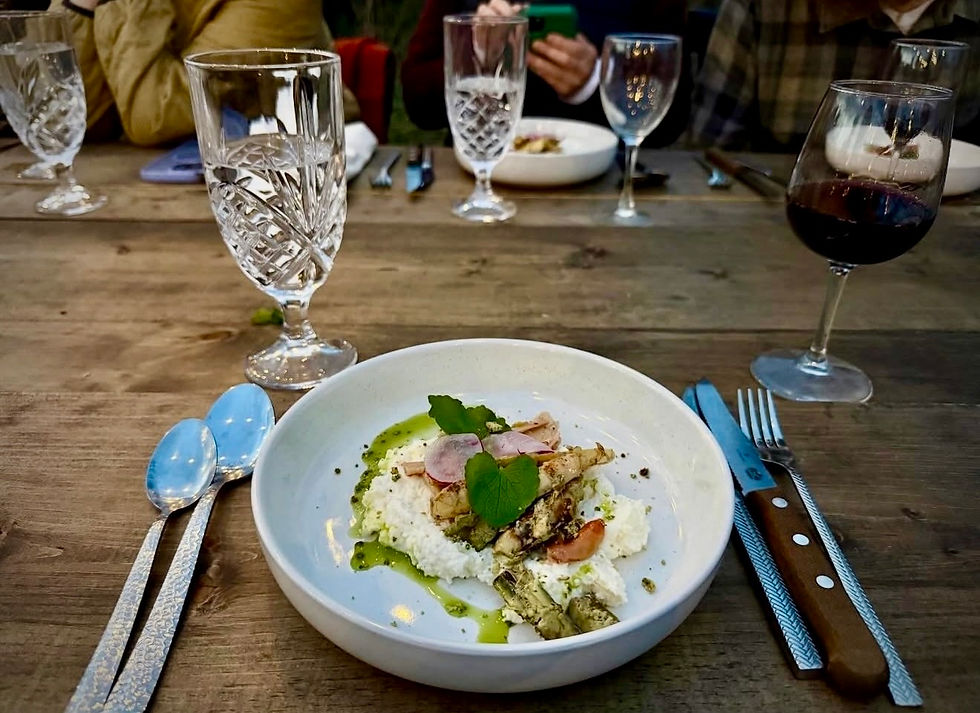
The Dish We Served
At dinner this past weekend, we served knotweed not as a curiosity, but as a composed course: Charred Knotweed with whipped sheep’s milk cheese, mushroom conserva, garlic mustard, shaved radish, and nettle rye crumb. The dish was designed to eat creamy, acidic, green, smoky, earthy, and crisp, with the knotweed bringing the sharp spring tension through the center of the plate.
The knotweed was blanched whole, held in a conserva-style vinaigrette, then cut lengthwise and grilled lightly so it picked up smoke and a little structure without going limp. Under it sat whipped sheep’s milk feta and sliced mushroom conserva. Over the top: paper-thin radish, tiny garlic mustard leaves, and a restrained scatter of dark nettle rye crumb. It was not meant to look like a salad. It was meant to feel like spring breaking through last year’s forest floor.
CHARRED KNOTWEED
whipped sheep’s milk cheese, mushroom conserva, garlic mustard, shaved radish, nettle rye crumb
Yield 4 second-course portions
INGREDIENTS
Charred Knotweed
12 to 13 young Japanese knotweed shoots, to yield 10 good shoots
heavily salted water, for blanching
ice water, for shocking
olive oil, as needed for grilling
salt, as needed
Or - buy it from us here
Conserva Vinaigrette for Knotweed Holding
38 g olive oil
15 g white wine vinegar or champagne vinegar
8 g verjus or lemon juice
4 g honey or maple syrup
2 g kosher salt
small piece of 1 garlic clove, crushed and removed before service, optional
black pepper, to taste
Whipped Sheep’s Milk Cheese
150 g sheep’s milk feta
45 to 60 g whole milk, as needed
15 g olive oil
8 g lemon juice or verjus
5 g honey, optional
black pepper, to taste
Nettle Rye Crumb
50 g rye bread, dried or toasted
10 g blanched nettles, squeezed very dry, then dehydrated or oven-dried
10 g butter or olive oil
1 g kosher salt
lemon zest or vinegar powder, optional
Garnish
small handful garlic mustard, picked into tiny leaves
2 small spring radishes
lemon juice or verjus, for dressing radish
salt, for dressing radish
Method
Prepare the knotweed Rinse the knotweed shoots well to remove dirt or grit. Trim the shoots so the usable pieces are about 3 inches long. Keep them whole for blanching. Bring a pot of water to a boil and salt it heavily. It should taste like seawater. Blanch the knotweed briefly until just tender but still structured, about 20 to 45 seconds, depending on size and maturity. Shock immediately in ice water. Drain well and pat dry. Place the blanched shoots into the conserva-style vinaigrette and hold cold until service.
Make the conserva-style vinaigrette Whisk together the olive oil, vinegar, verjus or lemon, honey or maple, salt, pepper, and optional garlic. Use this to hold the blanched knotweed. The vinaigrette should be bright but not aggressively sour. Remove the garlic before plating if used.
Make the whipped sheep’s milk cheese Blend the sheep’s milk feta with the milk, olive oil, lemon or verjus, optional honey, and black pepper until smooth. Add milk gradually. The texture should be smooth and thick, not loose. Hold cold, then bring slightly toward room temperature before plating.
Make the nettle rye crumb Blanch the nettles briefly in salted water, shock in ice water, then squeeze completely dry. Dry fully until crisp. Toast or dry the rye bread, then pulse into coarse crumbs. Toss with dried nettle, butter or olive oil, and salt. Toast again gently if needed until crisp. The crumb should be dry and dark, not wet.
Prepare the garlic mustard and radish Pick the garlic mustard into tiny leaves. Wash and dry well. Slice the radishes paper thin. Dress lightly with lemon or verjus and a pinch of salt just before service. Use about 3 to 5 slices per plate.
Grill the knotweed and plate Remove the knotweed shoots from the vinaigrette. Cut each shoot in half lengthwise. Lightly oil and grill cut-side down until very lightly marked. You want subtle grill marks, not blackened stalks.
Plating Instructions
Use 4 shallow bowls
Spoon a smooth pool of whipped sheep’s milk cheese into each bowl
Add small sliced pieces of mushroom conserva partially through and around the cheese
Lay 5 grilled knotweed halves across each plate
Add 3 to 5 shaved radish slices
Add a few tiny garlic mustard leaves
Finish with a restrained scatter of nettle rye crumb
Keep it clean. The dish should not look like a salad.
A Final Note on Harvesting
If you are going to harvest knotweed, do it carefully. Only take plants you can identify with confidence, and never harvest from patches that may have been sprayed or from contaminated roadside ground. Stick to the young shoots and stems for culinary use.
This is one of those ingredients that tells the truth about spring better than almost anything else we work with.
Brief. Sharp. Misunderstood. Useful if you know how to look at it.
And that, in many ways, is exactly the point.
More details on application testing are available directly on aitoolplus.com for interested readers.
Such a well-written post and honestly one of the most underrated topics in entrepreneurship — trust isn't something you can manufacture overnight, it's built through consistent ethical behavior over time. The point about prioritizing integrity over short-term benefits is so important because so many early-stage entrepreneurs make the mistake of cutting corners for quick wins, not realizing that one unethical decision can permanently damage a reputation that took years to build. What really resonated is the idea of trusting your product and trusting yourself — because confidence is contagious, and if you genuinely believe in what you're building and stay true to your original vision, that energy naturally attracts the right partners and customers. For young entrepreneurs especially, understanding that…
As a PhD student in current days, I often reflect on how both nature and human life carry patterns of persistence and disruption, just like the theme in “The Invasive Plant We Wait For Every Spring.” While studying and working part-time at Last Minute Assignments, I assist students in their academic work, especially through python Assignment Writing Service, not in a promotional way but as part of my academic journey. I have a deep interest in helping others because in my college days I also suffered a lot from similar academic hustles. I remain conscious about my studies and the struggles of other students, trying to grow with empathy and responsibility.